
SDG7: Affordable and Clean Energy

7.2.1 “Energy-efficient renovation and building
Have a policy in place for ensuring all renovations or new builds follow energy efficiency standards”
Bukhara State University strives to reduce energy consumption by ensuring that all new constructions and renovations follow energy efficiency standards. The university has a policy adopted by the Ministry of Construction and Housing and Communal Services of the Republic of Uzbekistan. The policy was built based on the manual developed by JSC “ToshuyjoyLITI”. The manual provides recommendations on the placement of buildings in the development, on the selection of the most energy-efficient space-planning and other solutions, on ensuring the necessary isolation and sun protection, sufficient natural lighting, and ventilation of the premises of public buildings. It also covers the use of solar energy and provides basic recommendations on selecting the most energy-efficient heating, ventilation, and air conditioning systems for public buildings.
7.2.2 “Upgrade buildings to higher energy efficiency
Have plans to upgrade existing buildings to higher energy efficiency”
7.2.4 “Plan to reduce energy consumption
Have an energy efficiency plan in place to reduce overall energy consumption”
The university has set objectives to enhance the energy efficiency of existing buildings. The Net-Zero Plan developed by the university includes 3 interim targets addressing energy efficiency:
- Interim Target 1 (2026): Install solar panels on university buildings to generate 50% of the total energy demand on campus.
- Interim Target 2 (2028): Increase energy efficiency by 20% through building retrofitting and technology upgrades.
- Interim Target 3 (2030): Implement smart energy management systems to optimise energy consumption and reduce wastage.
7.2.3 “Carbon reduction and emission reduction process
Have a process for carbon management and reducing carbon dioxide emissions”
Bukhara State University measures the total carbon footprint using a methodology developed by the University of Indonesia. A dedicated team measures carbon footprint in metric tons by considering metrics of annual electricity usage, the number of shuttle buses travelling inside the campus, the number of cars, and motorcycles entering the campus. Detailed calculations are provided below:
- CO2 (electricity) = (electricity usage per year (kWh))/1000×0,84 = (1666647 kWh)/1000×0,84 = 1400 metric tons
- CO2 (bus) = (number of shuttle buses in your university × total trips for shuttle bus service each day ×approximate travel distance of vehicle each day inside campus only (KM) ×240)/100×0,01 = (0 ×0 × 5 × 240)/100×0,01 = 0 metric tons
- CO2 (cars) = (number of cars entering your university × 2 × approximate travel distance of vehicle each day inside campus only (KM) ×240)/100×0,02 = (140 ×2 × 4 ×240)/100×0,02 = 53.76 metric tons
- CO2 (motorcycle) = (number of motorcycles entering your university × 2 × approximate travel distance of vehicle each day inside campus only (KM) ×240)/100×0,01=(0 ×2 ×5 ×240)/100×0,01 = 0 metric tons
- CO2 (total) = 1400 + 0 + 53.76 + 0 = 1,453.76 metric tons
Also, the university is making strides to reduce carbon emissions on campus. Annually, the population of the university participate in green activities addressing carbon emissions. These activities include tree planting, cycling to the campuses, using renewable energy, and restricting fuel cars from entering the campus.
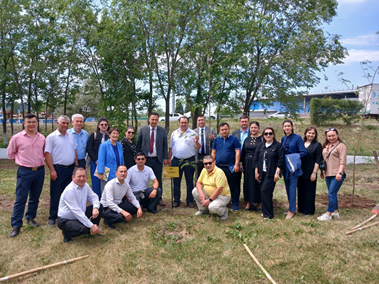
In late autumn, academic staff and students plant drought-tolerant trees in campus vegetation areas to improve air quality and reduce carbon emissions. Types of trees include pine, oak, mulberry, and juniper, which stay green all year round and improve the air on the campus, despite the low water consumption.
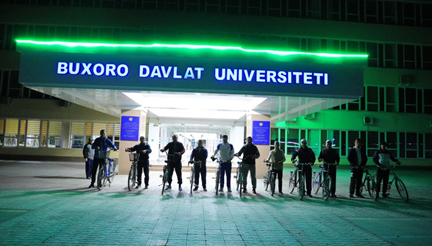
Starting in May, the university leadership hold special monthly cycling events to encourage professors and students to commute to the university by bicycle and limit the emissions of harmful gases.
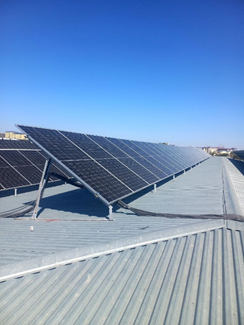
The solar panels from all campuses produced 1314000 KW/h in 2024.
| Stage | Building with solar panels | Energy produced per hour | Number of solar panels |
| 1 | Main building (main campus) | 170 KWT/H | 792 |
| 2nd and 3rd buildings (main campus) | 270 KWT/H | ||
| 2 | Dormitory blocks (main campus) | 565 KWT/H | 1028 |
| 3 | Agronomy faculty main building (agronomy and biotechnology campus) | 80 KWT/H | 145 |
| 4 | Main conference hall (main campus) | 20 KWT/H | 236 |
| Main building boxing sport facility(main campus) | 30 KWT/H | ||
| 5 | Main building 104 lecture room(main campus) | 80 KWT/H | |
| Total: | 1215 KWT/H | 2201 panels |
7.2.5 “Energy wastage identification
Undergo energy reviews to identify areas where energy waste is highest”
At Bukhara State University, energy wastage is detected with the use of electricity meters that are installed in all campus buildings. These electricity meters are connected to the software that monitors the use of electricity on the campus and identifies abnormal overuse.
7.2.6 “Divestment policy
Have a policy on divesting investments from carbon-intensive energy industries, notably coal and oil”
Bukhara State University strives to reduce its environmental impact by divesting funds from energy industries that use fossil fuels. The university’s NET-Zero plan aims at three targets addressing Carbon Offset and removal, including:
- Interim Target 1 (2030): Invest in verified carbon offset projects to offset 10% of the university’s remaining emissions that cannot be reduced internally.
- Interim Target 2 (2028): Implement afforestation and reforestation projects on campus and in nearby areas to sequester CO2.
- Interim Target 3 (2030): Collaborate with research departments to explore and support cutting-edge carbon removal technologies.
Additionally, the university has developed a sustainable investment policy which addresses key areas while making decisions on investments, including:
- Identifying opportunities to invest in funds or companies that reduce carbon emissions, promote social responsibility, and address climate change solutions.
- Supporting the University’s commitment to achieving Net Zero by 2045.
- Actions that contribute to global progress toward Net Zero or similar strategies, safeguarding the environment, climate, and biodiversity.
- Upholding human rights, including but not limited to gender, race, and religious equality.
- Promoting good business ethics and employment practices.
- Investing in and supporting community development.
- Encouraging sustainable provision and procurement of essential resources and services.
7.4 Energy and the community
7.4.1 Local community outreach for energy efficiency
Bukhara State University delivers knowledge to the local community to learn about the importance of energy efficiency and clean energy through public discussions, new programs in renewable energy, publications in the university newspaper and on social media.
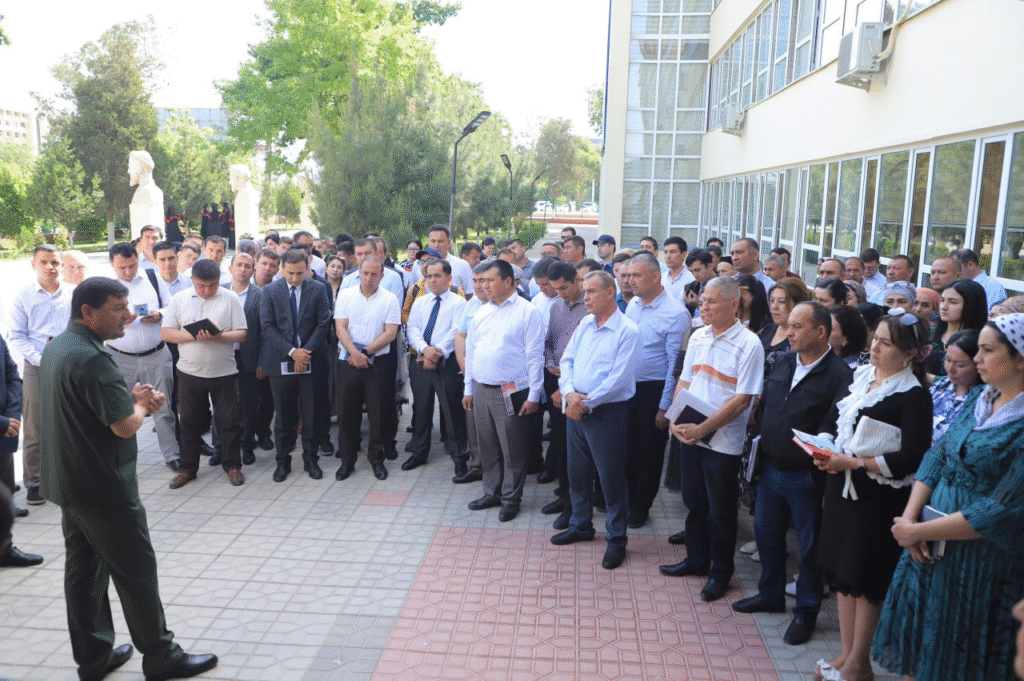
On May 2 2024, a discussion on reaching energy efficiency in home settings was held with the university staff and the local community. The regional prosecutor, the head of the regional department for the electricity network, and the head of the regional department for gas supply led the meeting and shared knowledge about energy efficiency in home settings, emphasising the opportunities for solar panels. The discussion not only revealed insights into energy efficiency through the transition to renewable energy, but also highlighted additional earnings via selling excess energy to the grid.
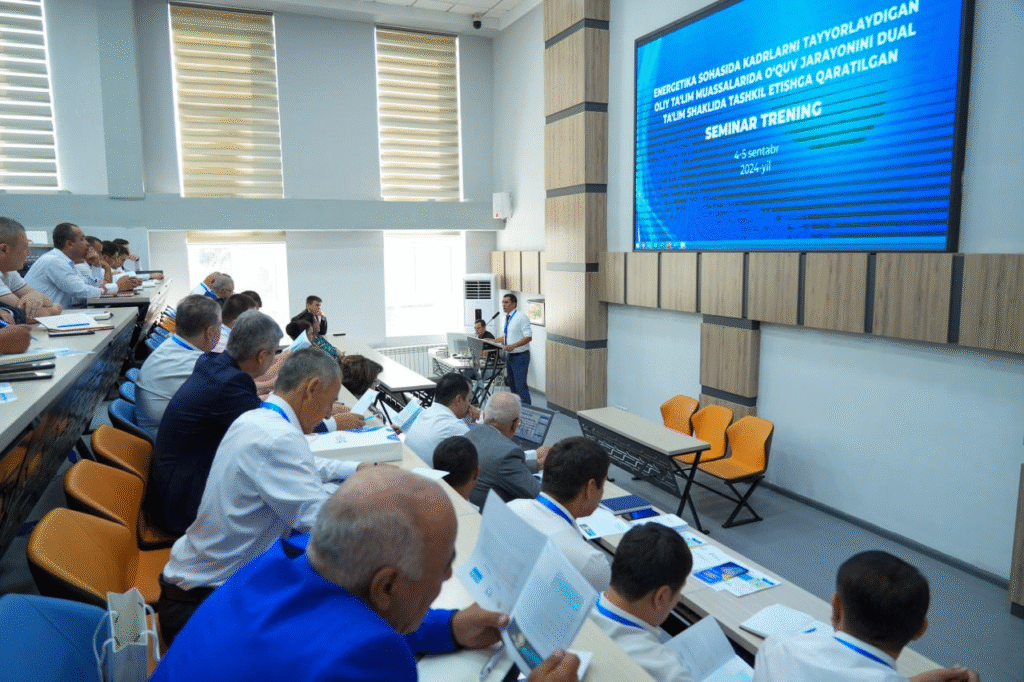
On September 4 2024, Professors from the energy department of Bukhara State University participated in a training on designing undergraduate programs in renewable energy. The newly developed curriculum will focus on creating an energy supply through alternative energy sources and will offer more than 30 quotes every academic year. The training also discussed energy efficiency and opportunities for using renewable energy in the country, which must be emphasised while developing the new programs.
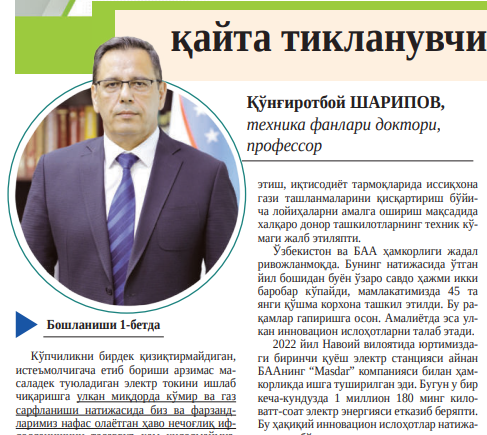
The importance of renewable energy was emphasised in the newspaper article by Kongratbay Sharipov, the rector of Tashkent State University of Economics. The rector highlighted the increasing demand for electricity caused by urbanisation, industry, and public services that require much energy to function properly. The article claimed that the transition to renewable energy sources would not only provide sufficient power to economies and households but also support effective management to accomplish the government’s plans. The newspaper article was republished in the Bukhara State University’s newspaper and promoted through social media channels to reach the local community.
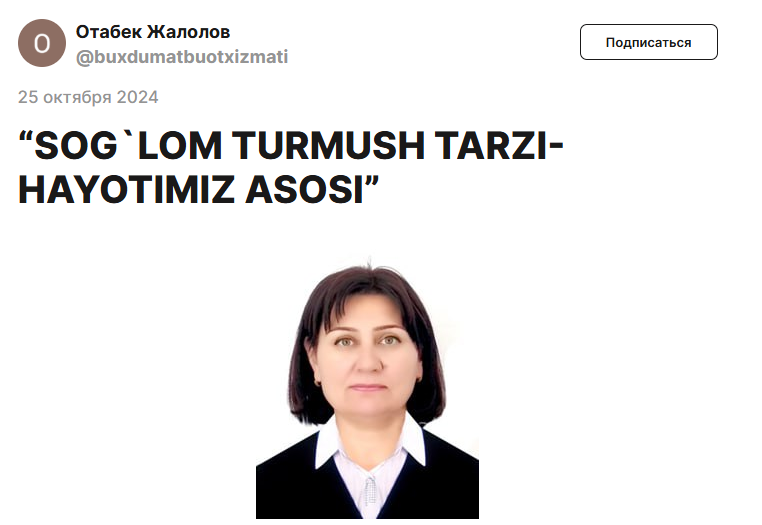
In an article posted on the university’s social media channels, Professor S.M.Mardonova from the ecology and geography department emphasised the use of renewable energy sources to deliver timely healthcare services to local communities. The paper stressed that due to a lack of energy, medical institutions are unable to improve their capabilities, leaving many people without appropriate healthcare treatment. However, this can be easily solved using renewable energy sources such as solar panels, which are low-cost and provide enough energy for over 300 days every year due to the location.
7.4.2 100% renewable energy pledge
Bukhara State University promotes a transition to 100% renewable energy sources through promotional videos on the use of solar panels, street billboards.
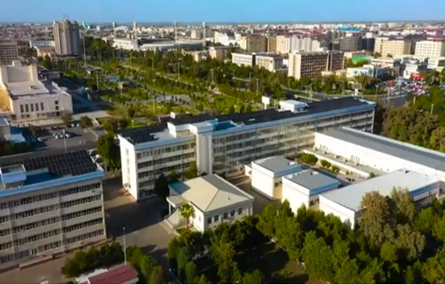
Bukhara State University has been actively promoting the use of renewable energy sources by showcasing solar panel installations which were set up on 9 buildings on 2 campuses. The video about solar panels was broadcast on the official channel of the Ministry of Higher Education, Science, and Innovations, on the university’s social media channels, and national TV channels to promote their use nationwide and highlight the environmental and economic benefits for citizens and organisations. https://t.me/buxdu_uz/34271
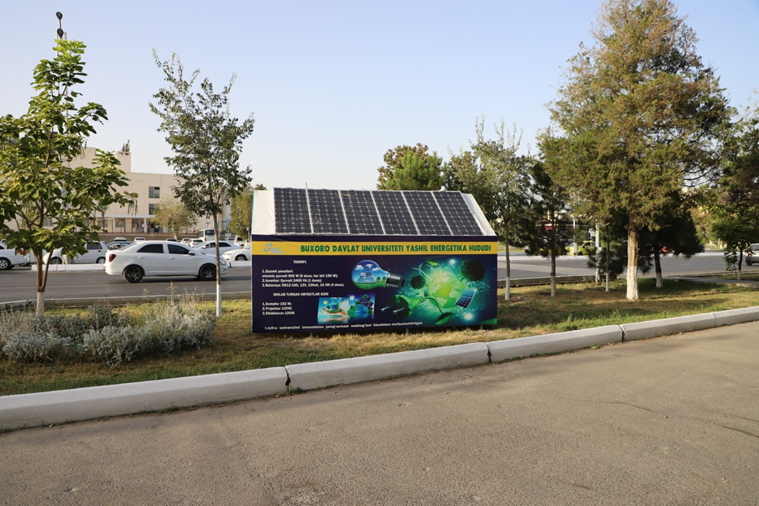
Another promotion informs people about the energy produced by a solar power station near the university campus. The solar panel station supplies electricity to an entrance barrier, traffic lights and a sidewalk light and informs people about the produced energy, the saved costs on electricity and the devices that are supplied through the solar energy.
7.4.3 Energy efficiency services for industry
Bukhara State University provides services to improve energy efficiency in local industries through solar energy training and research conferences.
On February 13, 2024, Professors from the renewable energy department conducted training about installing solar panels to provide practical support to all state and private organisations in the Bukhara region. During the seminar, the professors emphasised the financial and environmental advantages of solar panels, noting that solar power will not only reduce the environmental impact but also generate profit by selling excess energy.
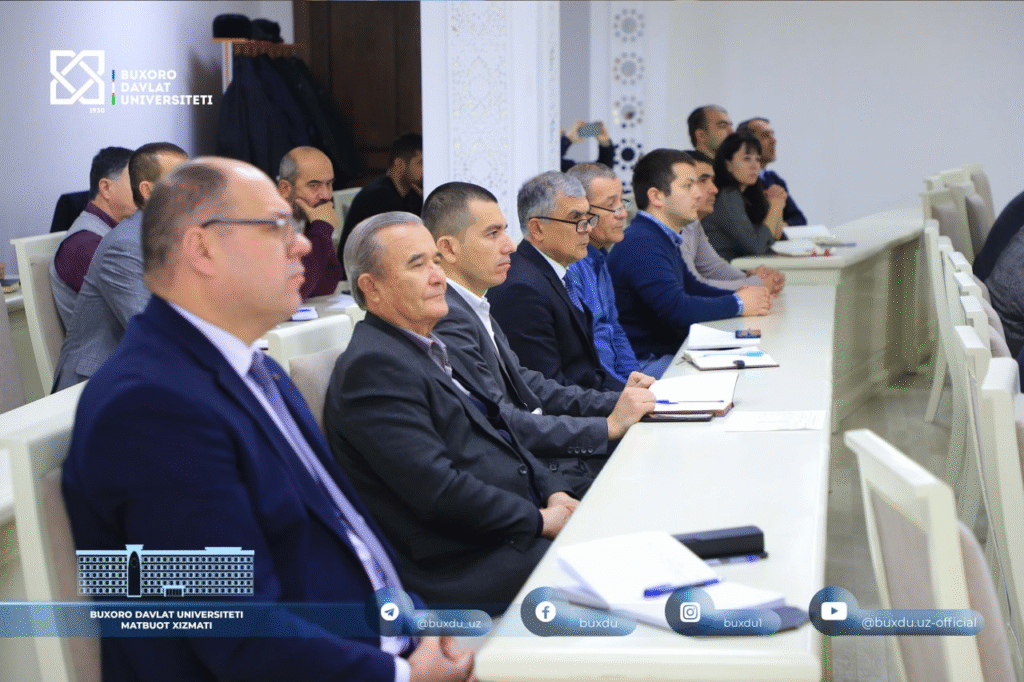
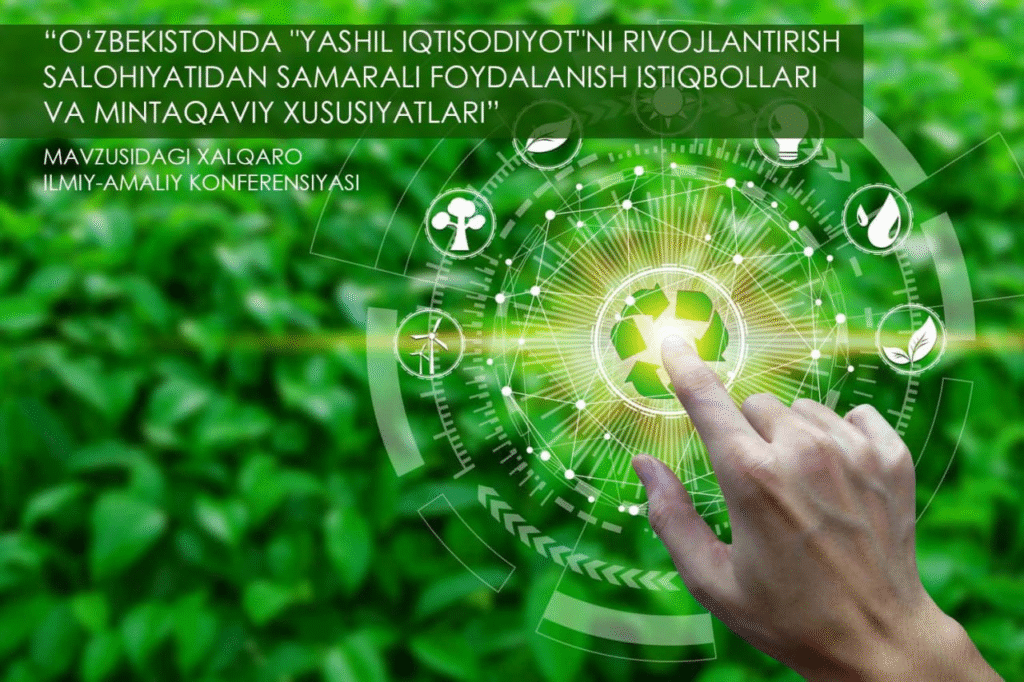
On April 12 2024, Bukhara State University organised a research conference focusing on opportunities for the green economy with renewable energy in Uzbekistan. The event welcomed stakeholders from industries and the local community. The conference experts shared their findings on the use of solar energy and their specifications that generate more energy in the climate. Participants from the industries learned new information about solar power and its economic and environmental benefits.
7.4.4 Policy development for clean energy technology
Bukhara State University supports governments in clean energy and policy development for energy-efficient technology through participation in educational forums, hosting national workshops and posting about government initiatives for environmental protection.
In February 2024, the rector of Bukhara State University made a speech at the Uzbekistan-Malaysia educational forum addressing the green economy. In his speech, the rector emphasised the significance of a 100% renewable energy supply in reaching energy efficiency and building an economy based on minimised environmental threat. The forum involved higher education leadership and stakeholders from Uzbekistan and Malaysia who joined the rector’s opinion and agreed to cooperate in this direction.
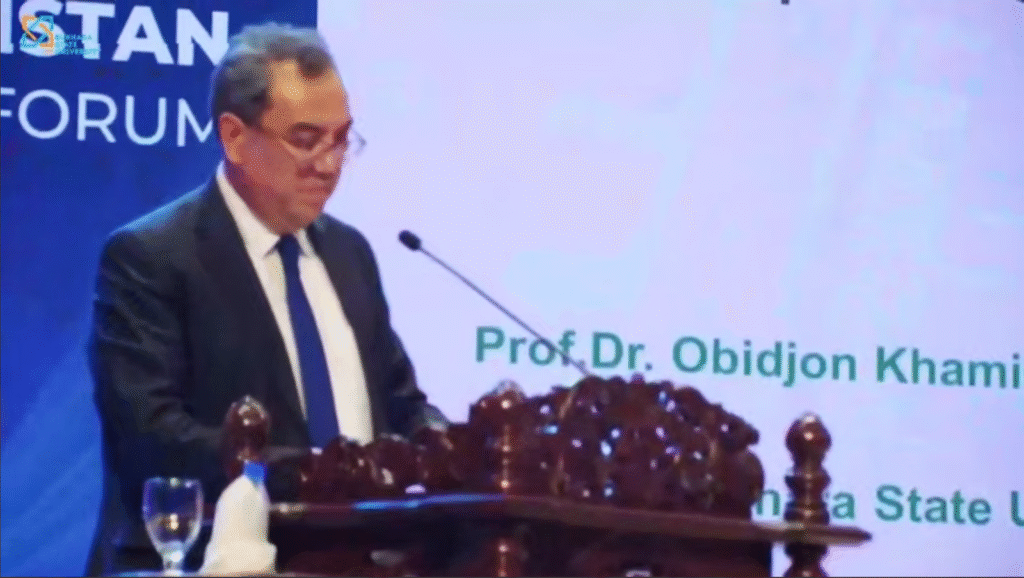
On December 26 2024, the university hosted a national workshop in partnership with UI Greenmetric – World University Rankings. The workshop focused on sustainability criteria for building green universities and involved higher education institutions from Uzbekistan. Bukhara State University was represented by the rector, Obidjon Khamidov, who shared insights into how the university, under his leadership, is moving towards 100% solar energy supply and stressed the benefits of the energy transition to encourage other higher education institutions to join this initiative.
Bukhara State University actively supports government initiatives addressing environmental issues. In December 2024, the president of Uzbekistan announced that 2025 would be the year of “Environmental protection and green economy”. Bukhara State University welcomed this initiative and emphasised the use of renewable energy sources in higher education and other industries to protect the environment and build a green economy. The university expressed its support for the government initiative through social media and encouraged the local community to join the project by switching to energy-efficient appliances and solar panels.
7.4.5 Assistance to low-carbon innovation
Bukhara State University assists start-ups and innovative projects that contribute to the green economy and low-carbon technologies through financing, consultations on international start-up contests and individual grants.
On August 1 2024, Bukhara State University organised a new competition of innovative solutions addressing ecological problems. Known as “Eco-innovation”, the contest received project applications in three fields, including environmental protection, fighting climate change, reducing and recycling waste, renewable energy sources, and eco-friendly technologies. The competition involved projects in the contest exhibition to demonstrate the strength of the projects and a thorough examination to identify the winners. The winners in the field of renewable energy sources were Jorabek Kamolov for the heating system based on solar energy, Volida Rahimova for the eco-friendly air purifying system, and Rustambek Safarov for lighting on renewable energy.
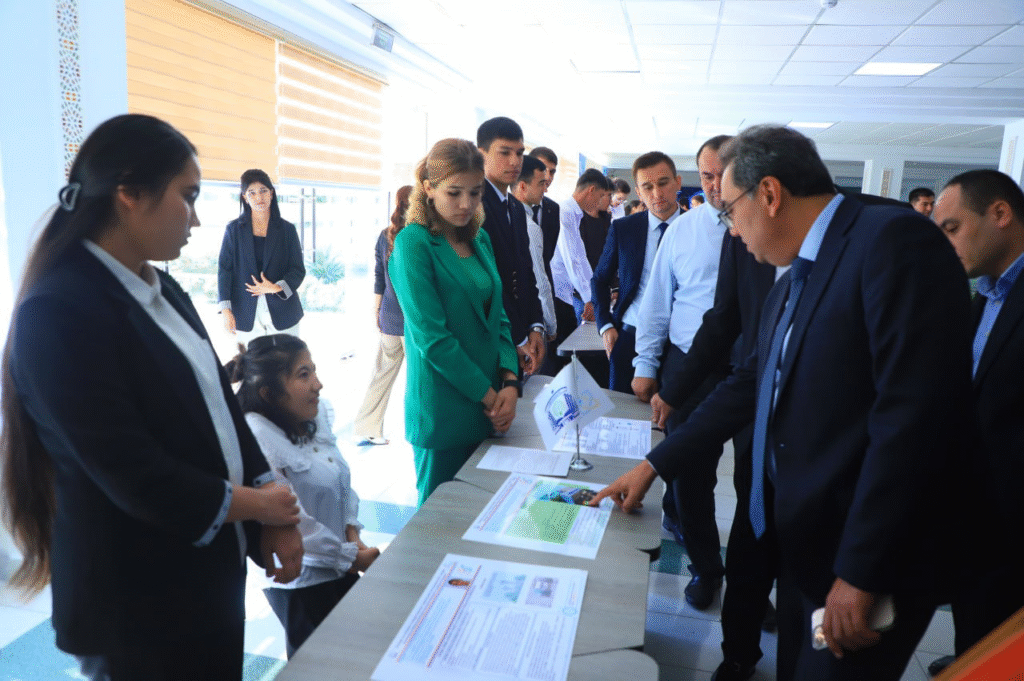
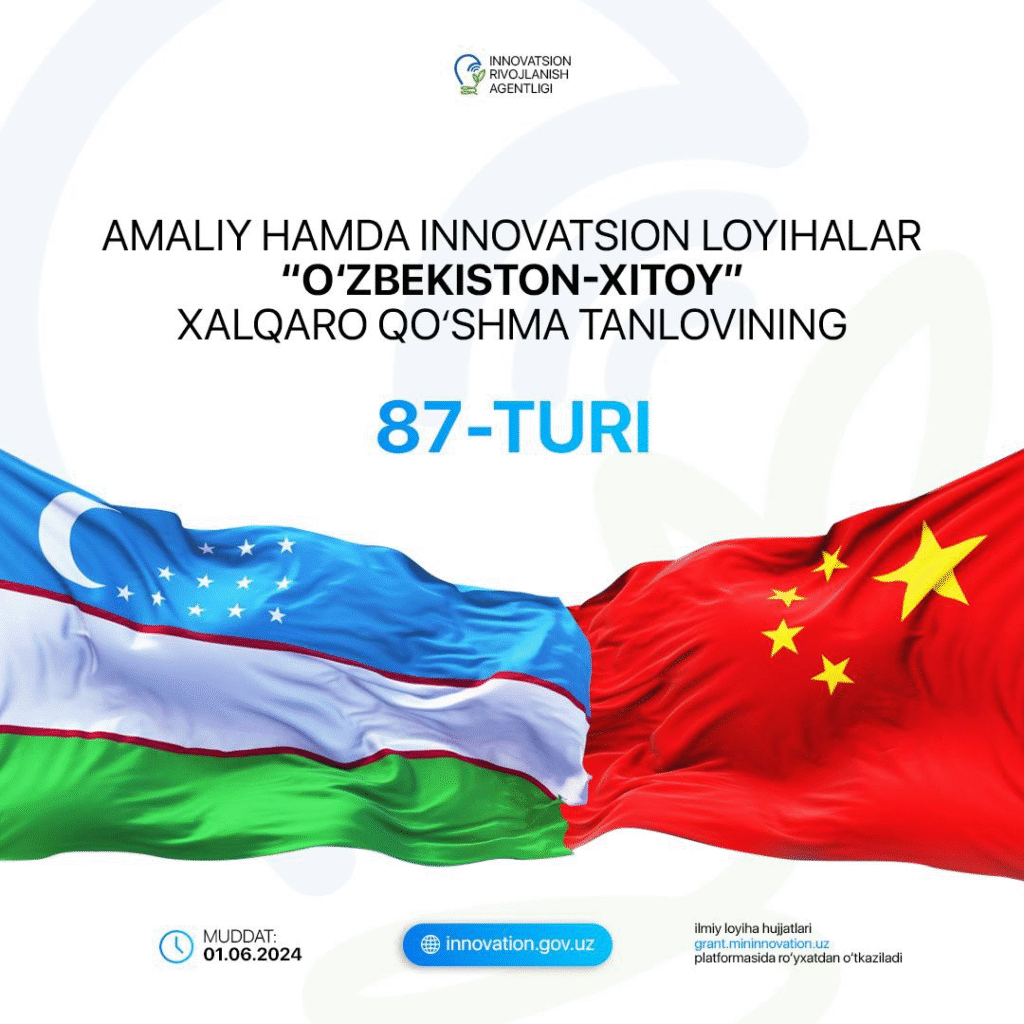
On April 30 2024, Bukhara State University launches support for the university staff and students aiming to design innovative projects and receive a grant from the Uzbekistan-China joint international contest. The university assists in consultations on project development and grant applications for various subjects, including renewable energy sources such as solar and wind-turbine power.
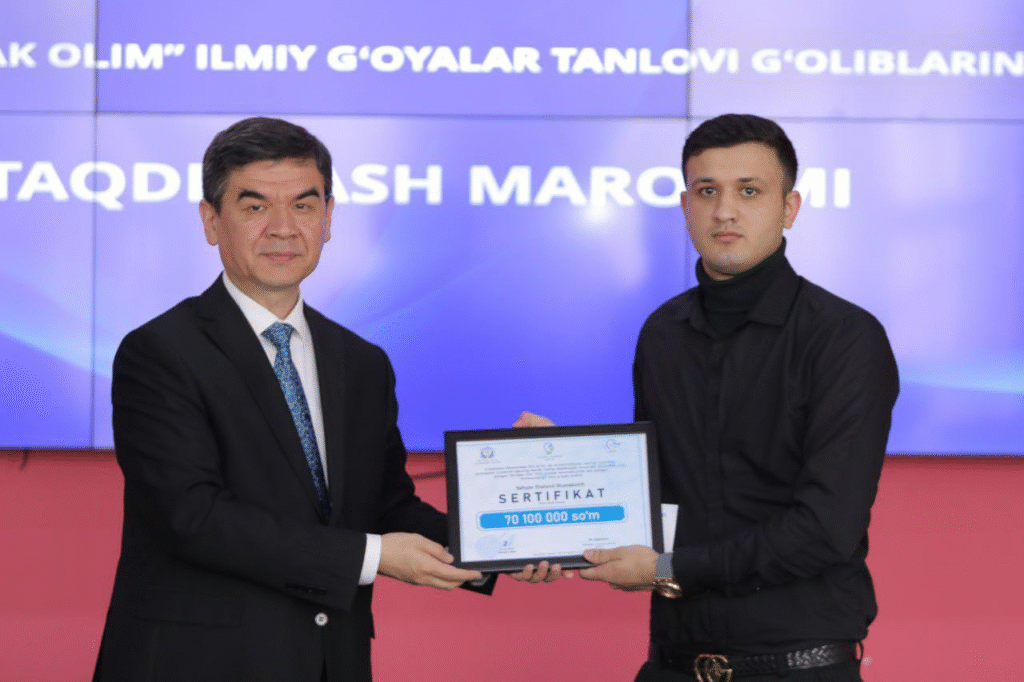
Furthermore, Bukhara State University give grants to individual projects built by the university students. On February 21 2024, the university announced the results for the grant known as “Scientists of the Future”. The winner was Shahzod Safoyev, who received 70 100 000 UZS for his innovative project called “Autocontainer”.
Energy Efficient Appliances Usage
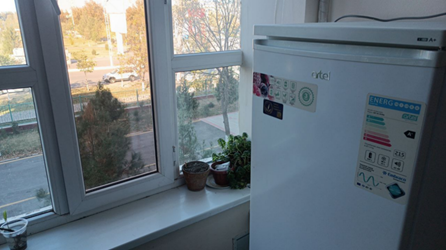
| Appliance | Total Number | Total number energy Efficient appliances | Percentage |
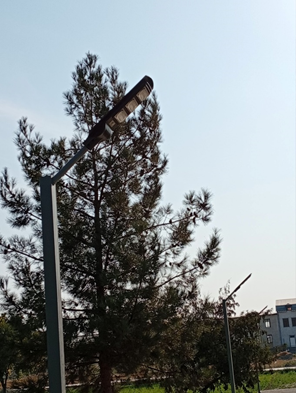
| Motion sensitive solar street lamps | 180 | 160 | 89% |
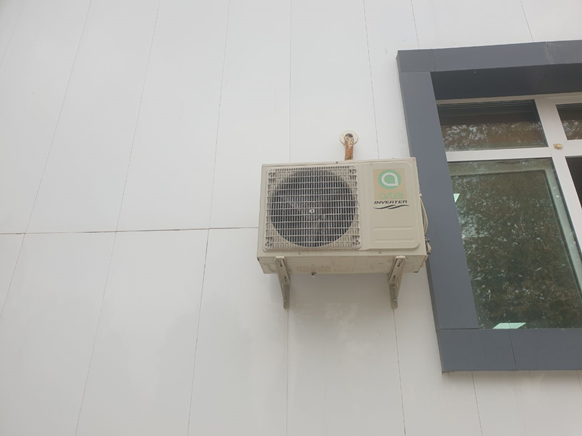
| Air conditioning system with inverted technology | 129 | 76 | 59% |
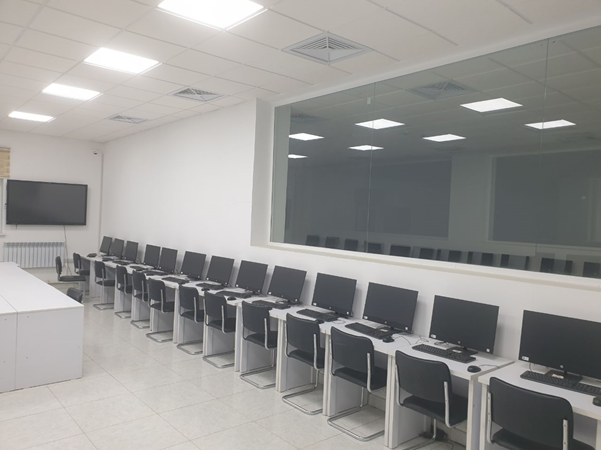
| Computers | 1620 | 1270 | 78% |
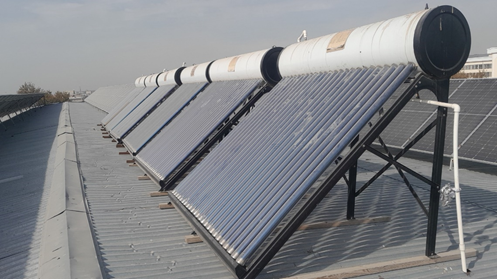
| Solar water heaters | 44 | 44 | 100% |
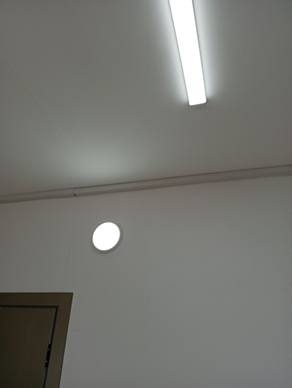
| LED Lamps | 31340 | 31340 | 69% |
| Energy efficient refrigerators | 18 | 15 | 83% |
| Solar panels | 2201 | 2201 | 100% |
| Average Percentage | 82% |
Bukhara State University is deeply committed to integrating sustainability into both its academic and administrative operations. Promoting efficient energy use stands among the institution’s key priorities and guiding principles. The university actively utilizes LED lighting, energy-efficient computers and air conditioners, motion-sensor streetlights, wall insulations, and solar power to minimize energy consumption and environmental impact.
Smart Building Implementation
| No. | Name | Place | automation | safety | energy | water | Indoor environment | lighting | Building Area (m²) | ||||||||||||
| B1 | B2 | S1 | S2 | S3 | S4 | E1 | E2 | A1 | A2 | I1 | I2 | I3 | I4 | L1 | L2 | L3 | L4 | ||||
| 1 | Bukhara state university; Main campus Main building | Bukhara, Uzbekistan | x | x | x | x | x | x | x | x | x | x | 16294 | ||||||||
| 2 | Bukhara state university; Main campus, central library of the university | Bukhara, Uzbekistan | x | x | x | x | x | x | x | x | x | x | 1776 | ||||||||
| 3 | Bukhara state university; Main campus, Second building | Bukhara, Uzbekistan | x | x | x | x | x | x | x | x | x | x | 20341 | ||||||||
| 4 | Bukhara state university; Main campus, IT centre | Bukhara, Uzbekistan | x | x | x | x | x | x | x | x | x | x | 480 | ||||||||
| 5 | Bukhara state university; Main campus, dormitory | Bukhara, Uzbekistan | x | x | x | x | x | x | x | x | x | x | 27930 | ||||||||
| 6 | Bukhara state university; Foreign languages campus, main building | Bukhara, Uzbekistan | x | x | x | x | x | x | x | x | x | x | 5002 | ||||||||
| 7 | Bukhara state university; Philology campus, main building | Bukhara, Uzbekistan | x | x | x | x | x | x | x | x | x | x | 8277 | ||||||||
| 8 | Bukhara state university; Agronomy and biotechnology campus, main building | Bukhara, Uzbekistan | x | x | x | x | x | x | x | x | x | x | 5666 | ||||||||
| 9 | Bukhara state university; Soktare campus building | Bukhara, Uzbekistan | x | x | x | x | x | x | x | x | x | x | 5080 | ||||||||
| Total | 90846 | ||||||||||||||||||||
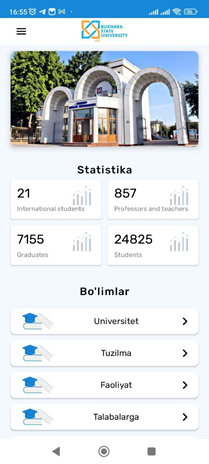
Building 1 (interactive support for users via APP)
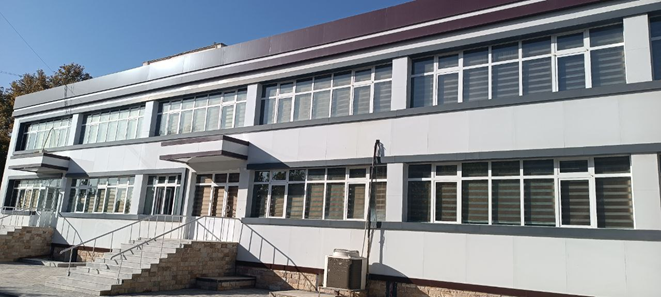
Building 2 (passive system for natural light exploitation)
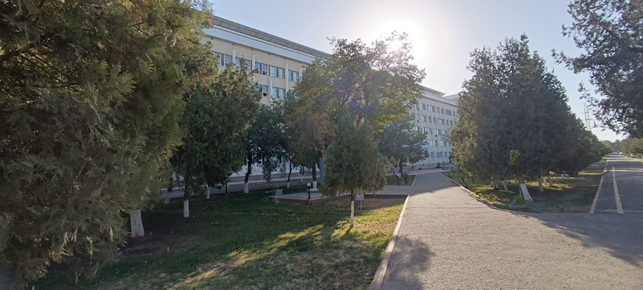
Building 3 (passive cooling through the shade of the building layout and trees along the building)
Building 4 (smoke-detecting system, warning speakers, led lighting )
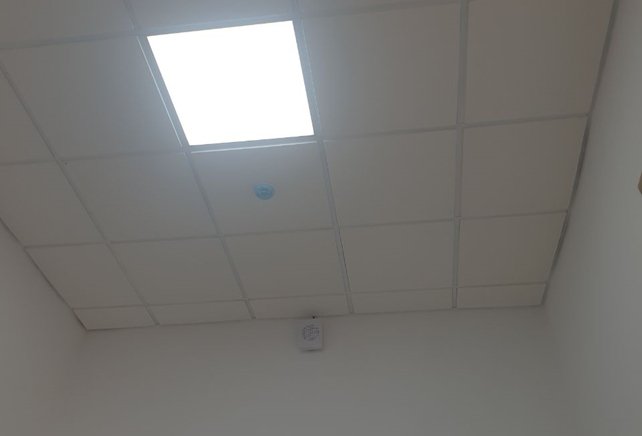
Building 5 (Rainwater recovery system for irrigation)
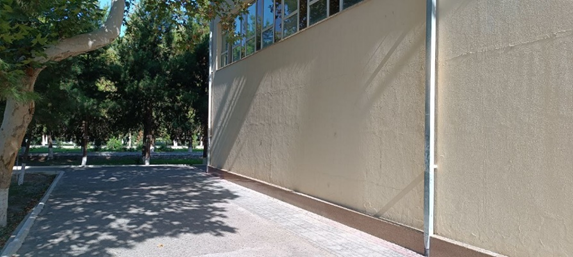
Building 6 (shielding adjustment and solar control with sunblinds)
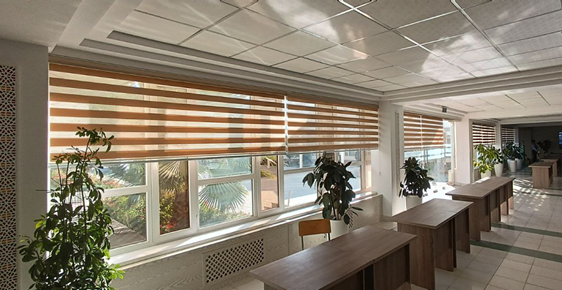
Building 7 (Intruder alarm system, red light in the right top corner of the photo)
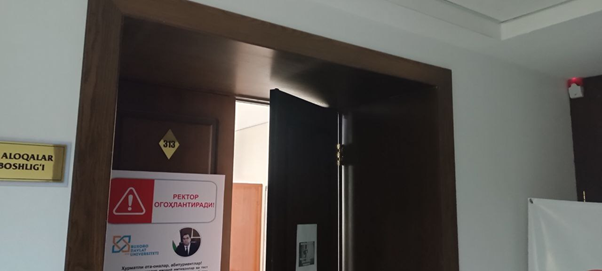
Building 8 (Finger print identification system)
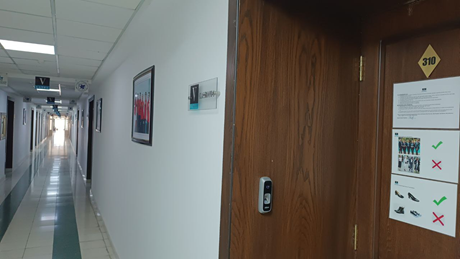
Building 9 (Smart fingerprint doorlock)

CCTV cameras for surveillance, ventilation systems and smoke detectors
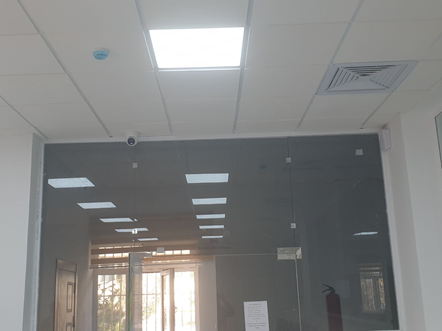
Renewable Energy Sources in Campus
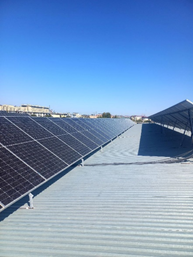
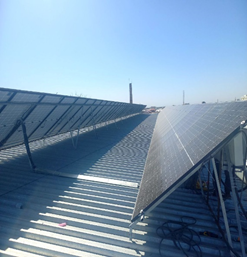
Roof Mounted Solar Panels are mounted on the buildings of Bukhara state university, main conference hall, boxing sports facility and lecture room 1/104 of the main campus in the year 2024. They annually provide electricity for the university
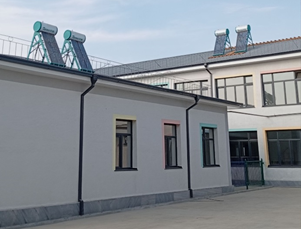
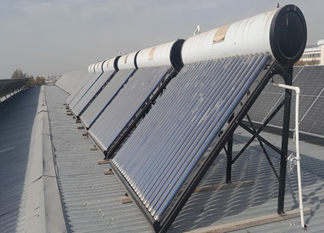
Roof Mounted Solar Collectors on the buildings of Bukhara state university, main conference hall, boxing sports facility and lecture room 1/104 of the main campus. They provide with hot water for the university
The solar panels from all campuses produced 1314000 KWT/H in 2024
| Stage | Building with solar panels | Energy produced per hour | Number of solar panels |
| 1 | Main building (main campus) | 170 KWT/H | 792 |
| 2nd and 3rd buildings (main campus) | 270 KWT/H | ||
| 2 | Dormitory blocks (main campus) | 565 KWT/H | 1028 |
| 3 | Agronomy faculty main building (agronomy and biotechnology campus) | 80 KWT/H | 145 |
| 4 | Main conference hall (main campus) | 20 KWT/H | 236 |
| Main building boxing sport facility(main campus) | 30 KWT/H | ||
| 5 | Main building 104 lecture room(main campus) | 80 KWT/H | |
| Total: | 1215 KWT/H | 2201 panels |
| Stage | Building with solar collectors | Number of solar collectors |
| 1 | Main building (main campus) | 44 |
| 2 | Soktare campus |
Electricity Usage per Year
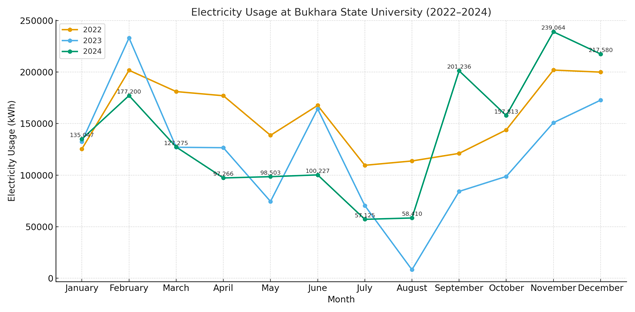
In 2024, the total electricity consumption of Bukhara State University from grid alone was amounted to 1,666,746 kWh. Across the main campus and its academic buildings, electricity is primarily used for lighting, cooling, heating, computer systems, and laboratory equipment. Energy management and optimization are key elements of the university’s sustainability strategy, reflecting its ongoing efforts to reduce carbon emissions and enhance operational efficiency.
Compared to previous years, the university’s energy usage demonstrates noticeable variation. In 2022, total consumption stood at around 1.78 million kWh, while in 2023 it slightly increased to 1.85 million kWh, largely due to expanded laboratory activities and digital infrastructure upgrades. The 2024 decrease of nearly 10% reflects the positive impact of energy optimization programs, including the widespread adoption of LED lighting, energy-efficient air conditioners, motion-sensitive street lighting, solar panels and solar-powered systems on campus. The electricity consumption in 2024 was decreased although university has enlarged its facilities with new buildings. One more cause of decrease in electricity consumption from grid is University is enlarging its solar power capacity. In 2024 University generated 1314000 Kw of electricity, from this 612 000 Kw was consumed and 702000 Kw was sold to the grid.
Total gas consumption dropped from 725,152 m³ in 2023 to 638,292 m³ in 2024, showing a 12% reduction.
The lower trend in late 2024 indicates successful solar and energy efficiency interventions such as 16 energy-efficient burners installed, mode adjustment work had been done and 2 boilers repaired to eliminate energy escapes.
Ratio of renewable energy production divided by total energy usage per year
| No | Renewable Energy | Production (in kWh) |
| Solar panel | 1,314,000 | |
| Total | 2,278,746 |
1,314,000/ 2,278,746 (Electricity usage) = 58 %
Elements of Green Building Implementation
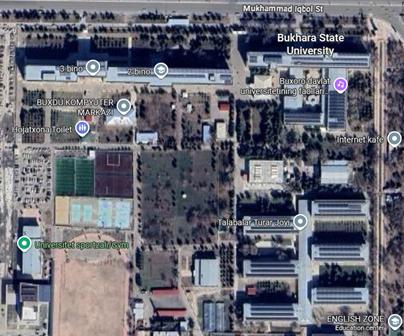
Green Building Implementation – solar panels and solar inverter
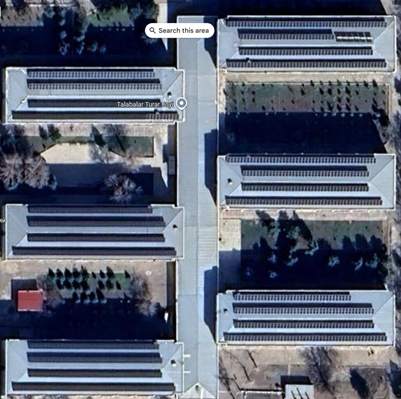
Sunlight reflecting roofing to reduce indoor heating
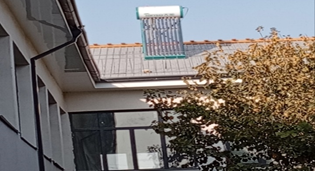
Solar collectors on top of buildings to generate hot water with sunlight
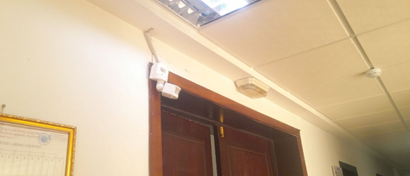
Motion sensor lights
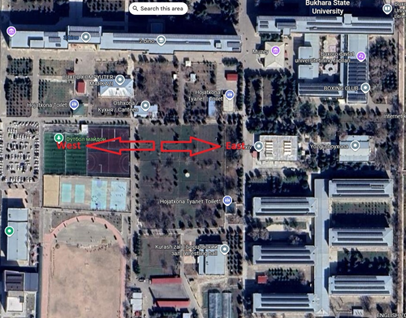
Passive solar systems through the elongated building layout on an east-west axis and glass facing south to use natural light and heat
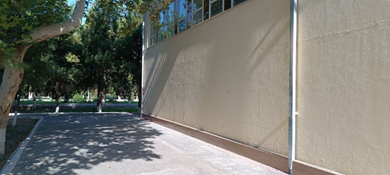
Rainwater collecting system
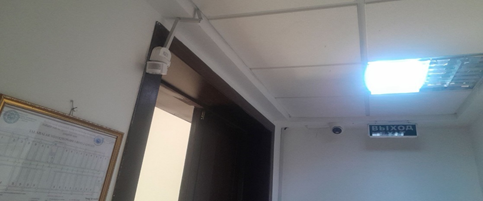
Windows control systems to adjust natural light exploitation and indoor plants to improve air quality
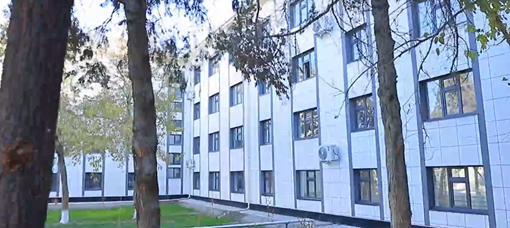
Walls covered with aluminum insulated panel to stimulate energy efficiency
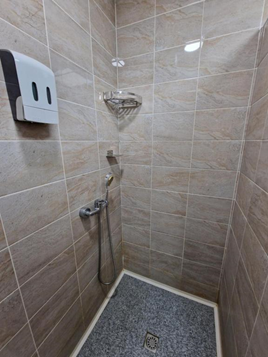
Water Efficient Appliances Usage
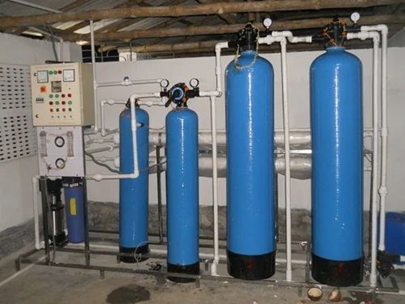
Consumption of Treated water
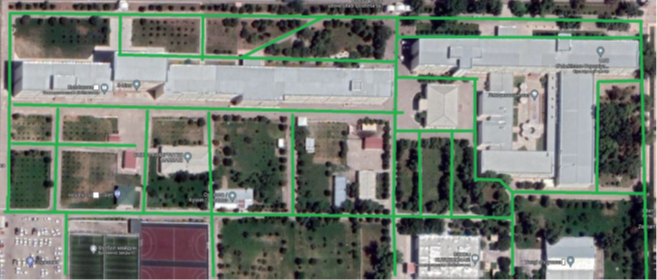
Buildings surrounded by green spaces
| GBI Non-Residential Existing Building | Main building | Building 2 | Building 3 | Dormitories | New Building | Soktare campus |
| Element 1. Energy Efficency | V | V | V | V | V | V |
| Design & Performance | V | V | V | V | V | V |
| Minimum EE Performance | V | V | V | V | V | V |
| Lighting Zoning | V | V | V | V | V | V |
| Electrical Sub-metering | V | V | V | V | V | V |
| Renewable Energy | V | V | V | V | V | V |
| Advanced or Improved EE Performance – BEI | ||||||
| Commissioning | V | V | V | V | V | V |
| Enhanced or Re-commissioning | V | V | V | V | V | V |
| On-going Post Occupancy Commissioning | V | V | V | V | V | V |
| Monitoring, Improvement & Maintenance | V | V | V | V | V | V |
| EE Monitoring & Improvement | V | V | V | V | V | V |
| Sustainable Maintenance | V | V | V | V | V | V |
| Element 2. Indoor Environmental Quality | V | V | V | V | V | V |
| Air Quality | ||||||
| Minimum IAQ Performance | ||||||
| Environmental Tobacco Smoke (ETS) Control | V | V | V | V | V | V |
| Carbon Dioxide Monitoring and Control | ||||||
| Indoor Air Pollutants | ||||||
| Mould Prevention | V | V | V | V | V | V |
| Thermal Comfort | ||||||
| Thermal Comfort: Controllability of Systems | V | V | V | V | V | V |
| Air Change Effectiveness | ||||||
| Lighting, Visual & Acoustic Comfort | ||||||
| Daylighting | V | V | V | V | V | V |
| Daylight Glare Control | V | V | V | V | V | V |
| Electric Lighting Levels | V | V | V | V | V | V |
| High Frequency Ballasts | ||||||
| External Views | V | V | V | V | V | V |
| Internal Noise Levels | V | V | V | V | V | V |
| Verification | ||||||
| IAQ Before/During Occupancy | ||||||
| Occupancy Comfort Survey: Verification | ||||||
| Element 3. Sustainable Site Planning & Management | V | V | V | V | V | V |
| Facility Management | V | V | V | V | V | V |
| GBI Rated Design & Construction | V | V | V | V | V | V |
| Building Exterior Management | V | V | V | V | V | V |
| Integrated Pest Management, Erosion Control & Landscape Management | ||||||
| Transportation | V | V | V | V | V | V |
| Green Vehicle Priority – Low Emitting & Fuel Efficient Vehicles | V | V | V | V | V | V |
| Parking Capacity | V | V | V | V | V | V |
| Reduce Heat Island Effect | V | V | V | V | V | V |
| Greenery & Roof | ||||||
| Building User Manual | V | V | V | V | V | V |
| Element 4. Materials & Resources | ||||||
| Reused & Recycled Materials | ||||||
| Materials Reuse and Selection | ||||||
| Recycled Content Materials | ||||||
| Sustainable Materials & Resources and Policy | ||||||
| Sustainable Timber | ||||||
| Sustainable Purchasing Policy | ||||||
| Waste Management | V | V | V | V | V | V |
| Storage, Collection & Disposal of Recyclables | V | V | V | V | V | V |
| Green Products | ||||||
| Refrigerants & Clean Agents | V | V | V | V | V | V |
| Element 5. Water Efficiency | V | V | V | V | V | V |
| Water Harvesting & Recycling | ||||||
| Rainwater Harvesting | V | V | V | V | V | V |
| Water Recycling | ||||||
| Increased Efficiency | V | V | V | V | V | V |
| Water Efficient – Irrigation/Landscaping | V | V | V | V | V | V |
| Water Efficient Fittings | V | V | V | V | V | V |
| Metering & Leak Detection System | ||||||
| Element 6. Innovation | ||||||
| Innovation & Environmental Initiatives | V | V | V | V | V | V |
| Green Building Index Facilitator |
The main campus of Bukhara state university stands on an east-west axis, which allows exploiting natural light for lighting and heating. The university strives to implement the elements of green building through absorption of sunlight for indoor heating and light, application of sunlight reflecting roofing, Rainwater collecting system, indoor windows control system to adjust natural light exploitation, indoor plants to improve air-quality, and green building materials such as wooden floors. The main building of the foreign languages campus has insulated walls with aluminum panels to provide efficient energy usage while heating and cooling.
Greenhouse gas emission reduction program
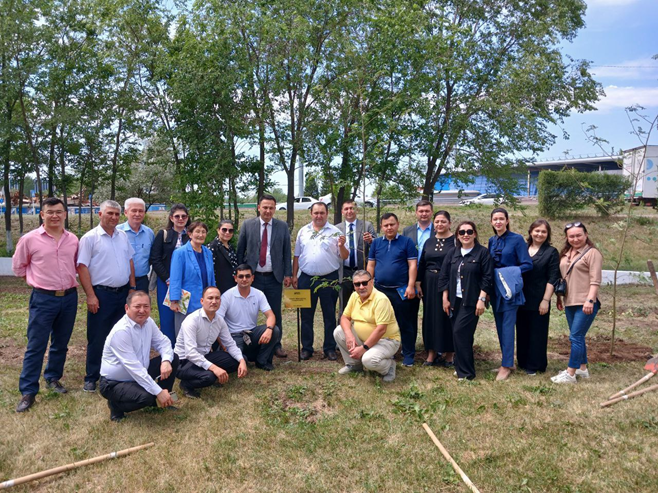
In-campus tree planting program
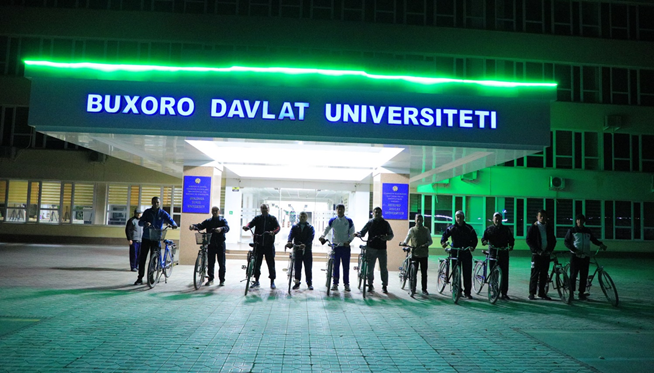
Green commuter monthly initiative
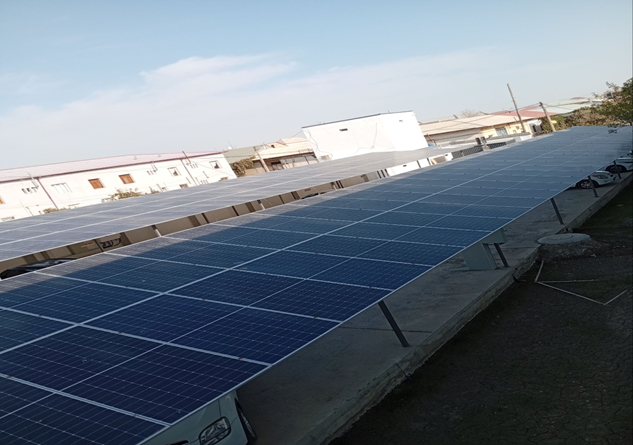
Renewable energy
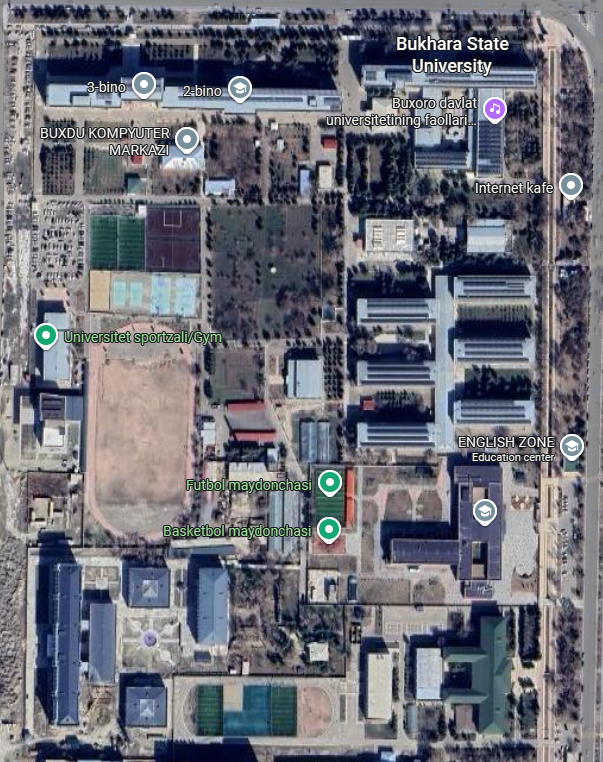
Car free campus program
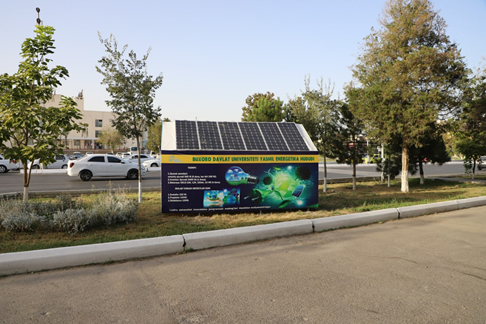
Promotion of renewable energy sources
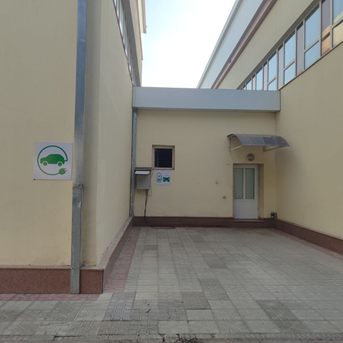
Electric vehicle free charging stations
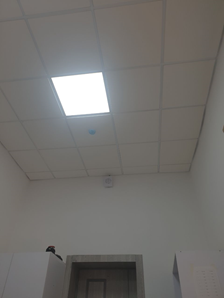
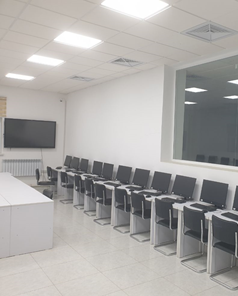
Energy effiicient appliances use
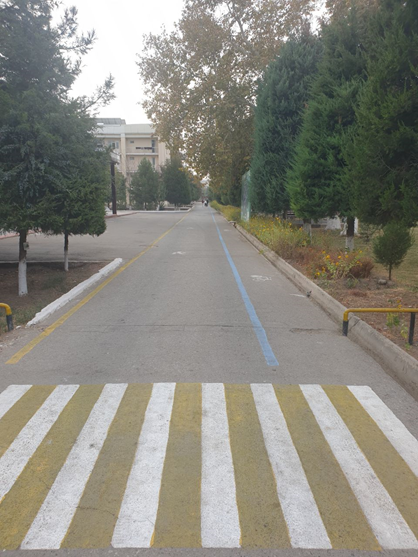
Car free pedestrian and bycycle paths
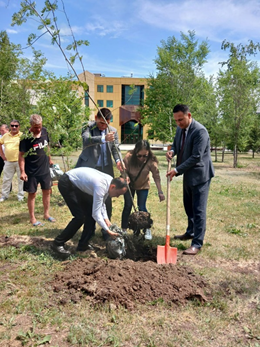
Urban Greening Partnerships outside of university
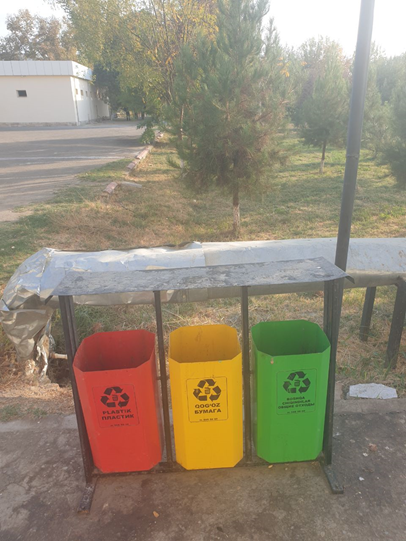
Waste Reduction and Recycling
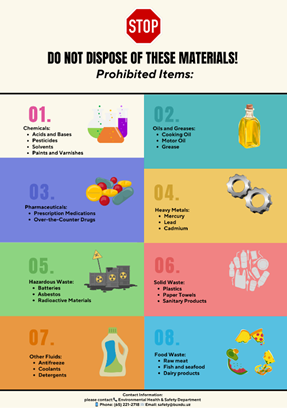
Education, Research & Awareness Programs
- Bukhara state university has initiated “Green Land” program to implement tree planting activities
- The university promotes “Green commuter” program to encourage its population to use public transport and bicycles.
- The university started to use renewable energy since February 2023
- The university sets restrictions on vehicle entry into campuses
- The university installed solar panels at the entrance of the main campus in order to raise awareness of renewable energy.
- There are free charging stations for electric vehicles
BUKHARA STATE UNIVERSITY
NET-ZERO PLAN
Introduction
Bukhara State University is committed to leading the way towards a sustainable
future by implementing a comprehensive net-zero plan. This plan outlines the
actions and interim targets the university will undertake to achieve carbon
neutrality and significantly reduce its environmental impact.
Vision
By 2040, Bukhara State University will strive for Net Zero Carbon (NZC) for Scope 1
and 2 emissions, with a reduction in Scope 3 emissions, and envisions itself as a
carbon-neutral institution,
where all emissions are balanced by equivalent carbon removal, energy efficiency
and sustainable practices. The university will be recognized as a sustainability
a leader within the higher education community, inspiring students, staff, and the
broader community to become environmentally conscious global citizens.
Actions and Interim Targets
- Energy Efficiency and Renewable Energy:
Interim Target 1 (2026): Install solar panels on university buildings to generate
50% of the total energy demand on campus.
Interim Target 2 (2028): Increase energy efficiency by 20% through building
retrofitting and technology upgrades.
Interim Target 3 (2030): Implement smart energy management systems to optimize
energy consumption and reduce wastage. - Sustainable Transportation:
Interim Target 1 (2026): Increase the use of electric and hybrid vehicles in the
university’s transport fleet to 20%.
Interim Target 2 (2026): Encourage the use of bicycles and promote public
transportation among students and staff, aiming to reduce single-occupancy vehicle
trips by 30%. - Waste Reduction and Recycling:
Interim Target 1 (2026): Implement a comprehensive waste management system
that diverts 30% of waste from landfills through recycling and composting
initiatives.
Interim Target 2 (2026): Promote the use of reusable water bottles, containers, and
other sustainable practices to reduce single-use plastic consumption by 50%.
Interim Target 3 (2025): Establish partnerships with local recycling facilities and
organizations to maximize recycling efficiency and explore innovative waste
reduction technologies. - Carbon Offset and Removal:
Interim Target 1 (2030): Invest in verified carbon offset projects to offset 10% of
the university’s remaining emissions that cannot be reduced internally.
Interim Target 2 (2028): Implement afforestation and reforestation projects on
campus and in nearby areas to sequester CO2.
Interim Target 3 (2030): Collaborate with research departments to explore and
support cutting-edge carbon removal technologies. - Curriculum Integration and Awareness:
Interim Target 1 (2026): Integrate sustainability and climate change topics into
20% of the university’s academic programs across disciplines.
Interim Target 2 (2025): Organize sustainability workshops, seminars, and
awareness campaigns to engage students, staff, and the local community in
sustainable practices.
Interim Target 3 (2025): Establish a sustainability center to promote research,
innovation, and outreach in environmental sustainability. - Engagement:
Interim Target 1 (2024): Engage with faculty, staff, students, and the local
community to gather feedback and ideas for sustainable initiatives.
Interim Target 2 (2025): Establish a sustainability committee comprising
representatives from different departments to guide and oversee sustainability
efforts.
Interim Target 3 (2026): Partner with local businesses, government
agencies, and NGOs to leverage resources and expertise for sustainability projects.
Monitoring and Reporting: The university will regularly monitor progress towards
achieving interim targets and the net-zero goal. Annual sustainability reports will
be published to transparently communicate results, challenges, and future action
plans.
By following this net-zero plan with clear actions and interim targets, Bukhara
State University aims to lead by example and contribute significantly to the global
efforts in combating climate change and securing a sustainable future for all.
Total Carbon Footprint
| Option 2: Recommended by UI GreenMetric CO2 (electricity) = 1,400,000 metric tons CO2 (bus) = 0 metric tons CO2 (cars) = 53.76 metric tons CO2 (motorcycle) = 0 metric tons CO2 (total) = 1,400,00+ 0 + 53.76 + 0 = 1,400,076 metric tons Carbon footprint in the last 12 months = 1,400,076 metric tons |
Innovative program(s) in energy and climate change

Master’s program in sustaianable bioeconomy
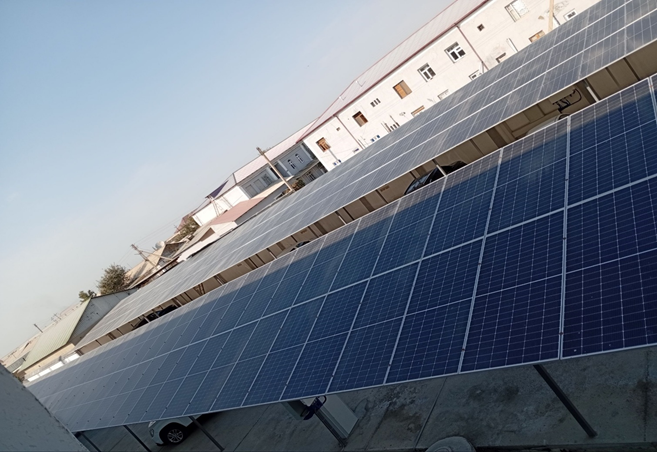
Air conditioning supplied by solar energy
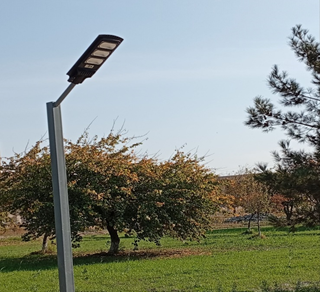
Street lamps with sensors and solar batteries
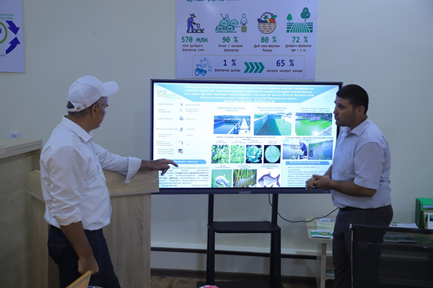
Cultivation of “Chlorella Vulgaris”
Bukhara state university has been implementing a number of programs addressing energy and climate change. In collaboration with partner universities, Bukhara state university is running a master’s degree program in sustainable bioeconomy. The goals of the program is To contribute to the development of sustainable and inclusive socio-economic growth in Uzbekistan. Addressing green energy, the university uses air conditioning systems supplied by solar energy, motion sensitive street lamps with solar batteries lighten the main campus when necessary. In addition, the university actively implements innovative field programs addressing climate change, such drip irrigation for cultivation of cotton, Cultivation of “Chlorella Vulgaris”, the algae that helps to purify irrigational water flow, and cattle waste recycle program to produce fertilizer.
Impactful university program(s) on climate change
| No | Programs | Scope (international / regional / national / local / etc) | Total Participants | URL | Short Description |
| 1 | “New Master’s Degree Curricula for Sustainable Bioeconomy in Uzbekistan” (BioEcUz) | International | 7 Students 12 Teachers | https://bioecuz.tdau.uz/ | Bioeconomy is a new sector for Central Asian countries and has been applied in several European countries since few decades. Bioeconomy is the production of renewable biological resources and the conversion of these resources and waste into value-added products, such as food, feed, chemical products, and bioenergy. The project is part of the Erasmus + capacity building program, and it will last for 3 years. |
| 2 | National workshop on UI GreenMetric for universities in Uzbekistan, May 26, 2023 | International | 5 rectors of universities from Uzbekistan, 20 experts in higher education and ranking. | https://greenmetric.ui.ac.id/article/the-1st-national-workshop-on-ui-greenmetric-world-university-rankings-for-universities-in-uzbekistan | The first national on UI Greenmetric was held at Bukhara state university which the national coordinator for universities from Uzbekistan to lead the participation in UI Greenmetric universities ranking. about the implementation sustainability principles within higher education. It highlighted the importance of raising awareness of climate change and the influence of human activity, creation of sustainable educational programs, adaptation of learners to sustainable lifestyle. |
| Virtual Workshop on UI GreenMetric for Universities in Uzbekistan. September 18, 2023 | International | 4 speakers 50 listeners (researchers and vice-rectors) | https://greenmetric.ui.ac.id/article/virtual-workshop-on-ui-greenmetric-for-universities-in-uzbekistan | The main goal of the workshop was to promote the participation of universities from Uzbekistan in world university rankings such as UI GreenMetric. The rector Bukhara state university Pr. Obidjon Khamidov and experts of university rankings from Indonesia delivered speech about the importance, necessity and participation of universities in sustainability rankings | |
| 4 | International symposium on “Oasis ecosystems amid climate change: challenges and solutions” | International | 5 speakers, 50 listeners (researchers and teachers) | https://t.me/buxdu_uz/35581 | The symposium on “Oasis ecosystems amid climate change: challenges and solutions” was held on October 11, 2023. It was attended by partner universities from Russia, Kazakhstan and experts from UI GreenMetric. The event highlighted the importance of sustainability in education for institutions located in Oasis areas such as Bukhara as well as revealed ways of reaching sustainability on campuses |
| 5 | “Green Nation” initiative | National | 2000 students 200 teachers (the number increases) | https://telegra.ph/Yashil-makon-loyihasida-BuxDU-talabalari-ham-faol-ishtirok-etishdi-10-27 https://t.me/buxdu_uz/30375 https://sdgs.un.org/partnerships/yashil-makon-green-nation-nationwide-afforestation-program#description https://buxdu.uz/yangiliklar/5276/5276-yurtimizni-yashillikka-burkaymiz/ https://t.me/buxdu_uz/30211 https://t.me/buxdu_uz/28732 | The “Yashil Makon”(“Green Nation”) initiative put forward by the President of Uzbekistan Shavkat Mirziyoyev in November 2021 envisages the planting of 1 billion tree and shrub saplings across Uzbekistan over the next five years. The main goal is to increase green areas of the country from the current 8 to 30 percent. The initiative is aimed at improving the overall management system in the field of selecting, planting and caring for trees. Bukhara state university actively participates in this initiative and organizes events to involve the university staff and students to contribute with their efforts. |
| 6 | The Second International Student Leaders Meeting | International | 20 speakers, 50 teachers, 100 students | https://t.me/buxdu_uz/37249 https://t.me/buxdu_uz/37242 https://t.me/buxdu_uz/37250 | In November 2023, BukhSU held the second international student leaders meeting titled “Innovation, Impact, and Future Directions of Sustainable Universities.” Students from Indonesia, Ecuador, Saudi Arabia, Pakistan, and top universities in Uzbekistan gathered to share their knowledge and experiences. The meeting included group discussions on topics such as water management, energy and climate change, waste management, transportation, education, and research. These sessions allowed students to exchange innovative ideas and develop strategies for promoting sustainability, including conscious water usage. |
| 7 | Unlocking The Future of Sustainable Tourism In Central Asia | International | 50 teachers, 100 students | https://tourism-workshop.mailchimpsites.com/ https://t.me/buxdu_uz/37955 https://t.me/buxdu_uz/37960 | A webinar on sustainable tourism revealing insights into Community-Based Tourism (CBT), Ecotourism, and Agrotourism in Central Asia. The webinar involved experts in CBT who shared insights into how communities in Central Asia can benefit from sustainable ways of developing tourism. |
| 8 | National seminar on “Sustainability Criteria and the Green University Concept: UI GreenMetric and Higher Education Institutions of Uzbekistan” | Local | 140 adminstrative and teaching staff of HEI | https://t.me/buxdu_uz/55292 | On December 26, 2024, an online national seminar was held on the topic “Sustainability Criteria and the Green University Concept: UI GreenMetric and Higher Education Institutions of Uzbekistan” in collaboration with Bukhara State University and UI GreenMetric World University Rankings. |
| 9 | Academician Nurislom Tokhliyev at Bukhara State University. | Local | 40 | https://t.me/buxdu_uz/54620 | The scientist held a roundtable discussion with the attendees on the topic of circular economy and green technologies. During his speech, he also touched upon the possibilities of waste recycling in the region and made his suggestions. |
| 10 | “Make room for life” mass plogging eco-campaign | Local | 30 | https://t.me/buxdu_uz/49820 | On September 20, in connection with the “World Cleanup Day” in our country, professors and students of the Department of Green Economy and Agribusiness of Buxoro State University actively participated in the mass plogging eco-campaign “Make room for life”. |
| 11 | International scientific and practical conference on “Prospects and regional features of effective use of the potential for the development of the “Green Economy” in Uzbekistan” | International | 50 | https://telegra.ph/Ozbekistonda-Yashil-iqtisodiyotni-rivojlantirish-salohiyatidan-samarali-foydalanish-istiqbollari-va-mintaqaviy-xususiyatlari-mav-04-26 | An international scientific and practical conference on the topic “Prospects and regional characteristics of effective use of the potential for the development of the “Green Economy” in Uzbekistan” was held. |
| 12 | “Green space” | Local | 12 | https://t.me/buxdu_uz/41870 | Professors and teachers of the Department of Green Economy and Agribusiness took the initiative to participate in the landscaping work in the “Star of the East” neighborhood of Bukhara, as part of the “Green Space” project, planting seedlings of various ornamental and fruit trees. |
| 13 | International scientific and practical conference on the topic “Scientific foundations of mitigating the consequences of global climate change” | International | 50+ | https://t.me/buxdu_uz/45594 | An international scientific and practical conference on the topic “Scientific foundations of mitigating the consequences of global climate change” was held. |
| 14 | “Life in a Drop” Video Competition | Local | 200+ | https://t.me/buxdu_uz/73173 | The video competition on the theme “Life in a Drop”, announced in collaboration with the Center for the Development of Nature and Human Capital and the Department of Green Economy and Agribusiness of Bukhara State University, has ended. This competition was organized to promote the idea of rational use of water among children aged 10-16, and the videos prepared by the participants were reviewed by a jury and the winners were determined. |
| 15 | Scientific Seminar Dedicated to “World Wetlands Day” | Local | Faculty, ecology department, students, specialists | https://t.me/buxdu_uz/38971 | Scientific-educational seminar by the Department of Zoology and General Biology on wetlands conservation. |
| 16 | “Green Space” Project – Tree Planting Campaign | Local | Over 100 decorative trees planted in Gijduvon and So’ficho’yan cemetery. | https://t.me/buxdu_uz/41710 | Over 100 decorative trees planted in Gijduvon and So’ficho’yan cemetery. |
| 17 | “Green Space” Spring Campaign with International Participants | International | English Philology Dept., students, international guest | https://t.me/buxdu_uz/42344 | Tree planting and cleaning activity near Presidential School and university campus. |
| 18 | Seminar-Training “Plogging: Promoting Eco-Culture and a Healthy Lifestyle” | Local | Youth Union & Eco Association | https://t.me/buxdu_uz/43140 | Training and eco-marathon to promote ecological culture and healthy lifestyle. |
| 19 | National Seminar on Environmental Education (Green University) | Local | University rectors, department heads | https://t.me/buxdu_uz/52519 | Seminar for 35 universities on SDGs, waste management, and sustainability education. |
| 20 | Community Meeting “I Love Nature” | Local | Faculty of Natural Sciences | https://t.me/buxdu_uz/52851 | Awareness meeting on ecology, desert flora and fauna, and saxaul conservation. |
| 21 | “Green Space” Tree Planting at University Sports Complex | Local | University administration, students | https://t.me/buxdu_uz/53875 | Trees planted as part of the national ‘Green Space’ initiative. |
Planning, implementation, monitoring and/or evaluation of all programs related to Energy and Climate Change through the utilization of Information and Communication Technology
| Stage | Activities/Programs | ICT Utilization | Evidence | Timeline | Responsible Team/Department |
| Planning | Assess potential for renewable energy installations | GIS mapping, renewable energy simulation software | Feasibility studies, site assessment reports | Jan 2023 – Apr 2023 | Building maintenance department, renewable energy and semiconductors department |
| Implementation | Installations solar panels | Project management tools, installation scheduling software | Installation logs, energy generation data | May 2023 – Dec 2023 | Building maintenance department, renewable energy and semiconductors department |
| Monitoring | Track renewable energy production | Renewable energy monitoring systems | Energy production reports, performance analytics | December 2024 | Building maintenance department, renewable energy and semiconductors department |
| Revision | Increase renewable energy production | Renewable energy simulation software, Renewable energy production tracking systems, analysis software | Energy production estimations, performance analytics | September 2025 | Building maintenance department, renewable energy and semiconductors department |
- Planning: Conduct feasibility studies using GIS mapping and renewable energy simulation software to assess potential sites for solar panel installations.
- Implementation: Oversee the installation of solar panels, tracking progress with project management tools.
- Monitoring: Use renewable energy monitoring systems to track energy production, generating performance reports and analytics.
- Revision: Use renewable energy simulation software, renewable energy production tracking systems, analysis software to improve energy production.
Impact of Energy and Climate Change programs in supporting the Sustainable Development Goals
Bukhara State University implements a comprehensive set of energy and climate action programs designed to reduce emissions, promote renewable energy use, and enhance sustainability across its campus and community. These initiatives are key elements of the university’s Net-Zero Plan (2024–2030) and are deeply aligned with the UN Sustainable Development Goals (SDGs).
Key programs and activities include:
– Renewable Energy Deployment: Installation of more than 2000 solar panels and solar-powered water heaters to generate clean electricity.
– Smart Green Campus Initiative: Integration of IoT-based smart metering systems, digital dashboards, and motion-sensitive lighting.
– Energy Efficiency Upgrades: Replacement of traditional lamps with over 30,000 LED units and inverter-type air conditioners.
– Climate Resilience and Awareness Programs: Tree-planting campaigns under the ‘Yashil Makon’ project and EcoInnovation Week.
– Sustainable Mobility Policy: Encouragement of walking, cycling, and electric service vehicles on campus.
– Water and Waste Efficiency: Implementation of rainwater harvesting, drip irrigation, and waste segregation systems.
– Digital Management for Sustainability: ICT-based platforms like Suvni Asra Dashboard for real-time monitoring of energy and water use.
These efforts directly support SDGs 3, 4, 6, 7, 9, 11, 12, 13, 15, and 17, and also contribute indirectly to others, including:
| SDG | Direct Impact at BukhSU |
| SDG 7: Affordable and Clean Energy | Increased renewable energy share through solar installations and efficient energy management systems. |
| SDG 9: Industry, Innovation, and Infrastructure | Development of smart infrastructure with IoT sensors, data-driven analytics, and renewable energy labs. |
| SDG 11: Sustainable Cities and Communities | Creation of a green, pedestrian-friendly campus with low-carbon mobility solutions. |
| SDG 12: Responsible Consumption and Production | Reduced energy and water use, paperless systems, and campus recycling initiatives. |
| SDG 13: Climate Action | Carbon reduction programs, emission monitoring, and awareness campaigns for climate resilience. |
| SDG | Indirect Contribution at BukhSU |
| SDG 3: Good Health and Well-Being | Improved air quality and reduced heat island effects create a healthier learning environment. |
| SDG 4: Quality Education | Integration of sustainability and renewable energy topics into academic programs. |
| SDG 6: Clean Water and Sanitation | Rainwater harvesting and efficient irrigation reduce water stress in Bukhara’s arid climate. |
| SDG 15: Life on Land | Tree-planting and biodiversity enhancement through campus greening efforts. |
| SDG 17: Partnerships for the Goals | Collaboration with government, NGOs, and international partners on sustainability projects. |